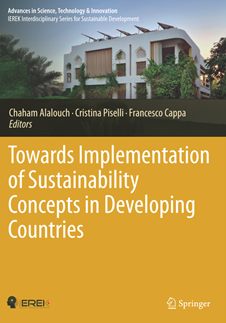
Alalouch, C., Piselli, C., Cappa, F. (Eds). (2021). “Towards Implementation of Sustainability Concepts in Developing Countries”, Switzerland, Springer, ISBN: 978-3-030-74348-2. Advances in Science, Technology & Innovation (ASTI) referred book series.
This book focuses on sustainability concepts in architecture and urban design, environmental issues, and natural resources. Today it has become essential to reduce carbon emissions, protect habitats, and preserve the delicate ecosystems of our planet. Accordingly, sustainable development has to be improved by decreasing the consumption of non-renewable resources, in order to help nature replenish itself. Further, it highlights the efforts that have been made by architects, environmentalists, engineers, students, planners and everyone in between in order to improve sustainability in various developing communities and countries.
Saleh, M. S. and Alalouch, C. (2020). Sustainable construction in Oman: the potential role of the industrialized building systems. The Journal of Engineering Research, 17(1), p. 1-10.
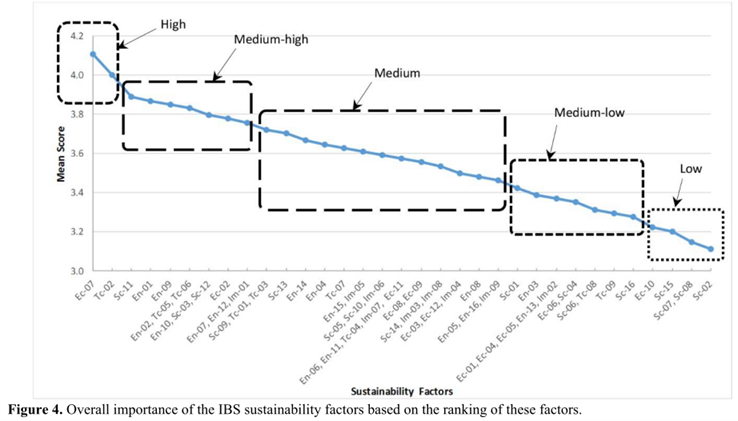
The Omani construction industry has been recently witnessing a boosted expansion associated with the notable growth in population and economy. In comparison with its neighboring countries, the construction industry in Oman is criticized for the lack of sustainability practices. Recently, the government and professional bodies have taken proactive actions to promote sustainable construction practices. The Industrialized Building Systems (IBS) could play an important role in the Omani’s construction industry in the future due to its environmental, economic, and social benefits. However, the lack of evidence on the contribution of IBS to the Omani’s construction industry suggests that this approach is not yet at top of stakeholder’s agenda. This paper focuses on the potential contribution of IBS on sustainable construction practices in Oman. Through literature review, a comprehensive list of sustainability factors affecting IBS applications in the Omani construction industry was developed. A stakeholder survey of Omani construction industry including clients, engineers, and contractors was conducted to understand their perception on the importance of these factors. The statistical analysis revealed that the environment-related and the implementation-related factors are more important than the social-related factors. The Economic-related factors were not found to be significantly more important than any other group of factors. Moreover, Construction Time was found to be the most important and the most influential factor among the 62 factors considered in this study. The paper concludes with recommendations to promote and improve applications of Industrialized building system in the Omani construction industry.
Alalouch, C., Al-Saadi, S., AlWaer, H., and Al-Khaled, K. (2019). Energy Saving Potential for Residential Buildings in Hot Climates: The Case of Oman. Sustainable Cities & Society, 46:101442.
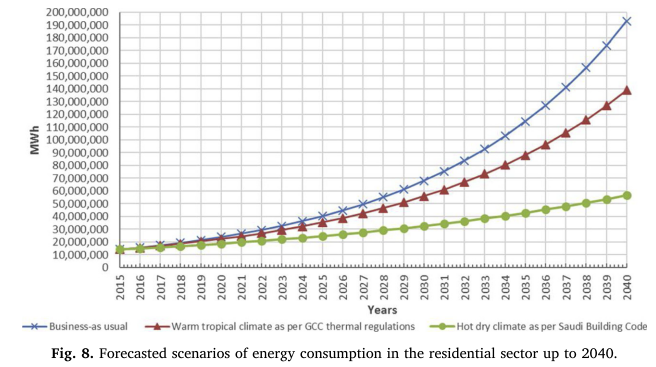
This paper examines the potential of energy saving in electrical consumption if the concept of energy-efficient house is implemented in Oman. Energy consumption in the residential sector in Oman was critically analysed and forecasted based on its growth rate and its historical consumption. Then, a base-case validated simulation model for a typical residential dwelling in different cities was generated using a dynamic building simulation software, covering a wide variation of climate conditions in Oman. A variety of modified design cases that met the minimum requirements for code compliance in residential buildings for four Gulf Cooperation Council countries were developed and subsequently simulated. Then, an economic analysis was performed. The results showed that due to the high annual growth rate of the residential sector (28.5%), a considerable amount of energy (13.2% in warm tropical climate to 48% in hot dry climate) could be saved if proper building codes are put in place. Thus, this paper calls for immediate action to start a large scale programme to promote and subsequently, to enforce the use of the principles of energy-efficient house in Oman.
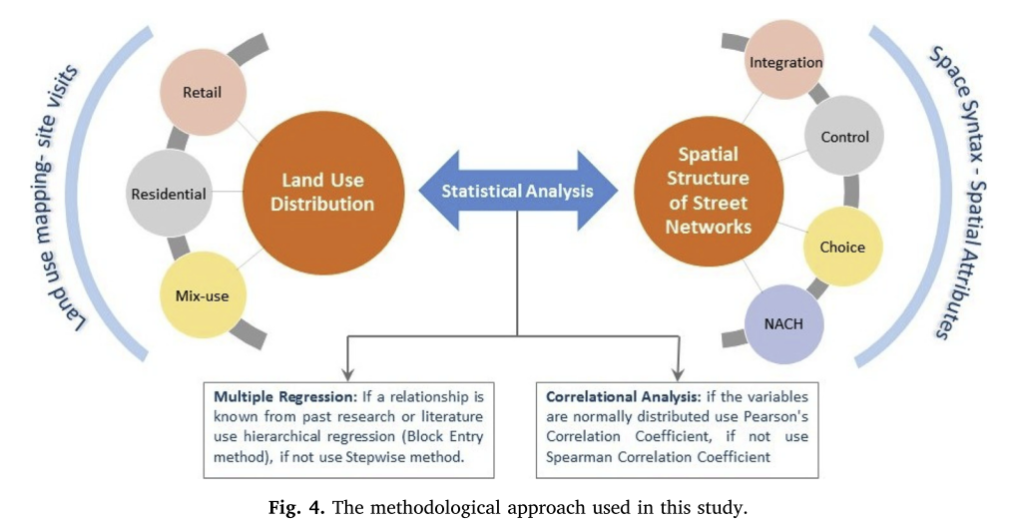
Alalouch, C., Al-Hajri, S., Naser, A., and Al Hinai, A (2019). The Impact of Space Syntax Spatial Attributes on Urban Land Use in Muscat: Implications for Urban Sustainability. Sustainable Cities & Society, 46:101417.
It is widely accepted that land-use distribution has a direct impact on urban sustainability. This study examines the relationship between land-use distribution and the spatial structure of street networks in newly developed neighborhoods as a contribution to urban sustainability. Two new neighborhoods in Muscat, Oman, were examined using Space Syntax theory. The land use maps were developed through exhaustive site visits, while the spatial analysis was generated using DepthMapX software. The following four spatial attributes were included: Integration, Control, Choice, and Normalized Least Angle Choice (NACH). The land use variables were Retail, Residential and Mix-use. The statistical analysis showed that the distribution of the Residential land use is significantly influenced by the spatial attributes in highly “intelligible” spatial configurations, with NACH being the best predictor followed by Integration. In addition, the degree to which an area has a formal grid structure was found to have no effect on the relationship between the variables. Thus, this paper contributes to urban sustainability, Space Syntax, and land-use distribution studies by providing evidence on how spatial arrangements influence land-use distribution, and consequently, energy use, demand for services, and patterns of urban traffic. The study concludes with recommendations to the planning authorities.
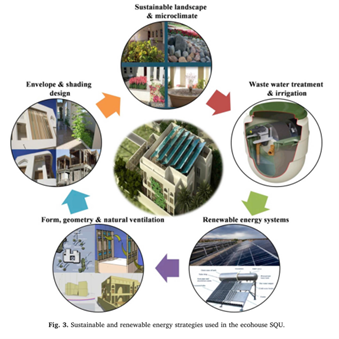
Al-Saadi, S. N., & Shaaban, A. K. (2019). Zero energy building (ZEB) in a cooling dominated climate of Oman: Design and energy performance analysis. Renewable and Sustainable Energy Reviews, 112, 299-316
Zero energy buildings (ZEBs) are targeted by several developed countries around the world which consequently promotes the progress toward achieving ZEBs. The concept of ZEBs is, however, uncommon in developing economies such as Oman. In 2011, The Research Council of Oman has announced a competition to design, construct and operate buildings that embrace sustainability principles. The first five eco-friendly buildings were designed and constructed by academic institutions in different climatic conditions of Oman. This project has significantly contributed toward raising awareness of energy efficiency and renewable energy systems in buildings. This paper outlines the design of sustainable energy systems of one of these five buildings. The ZEB prototype is located at the Sultan Qaboos University campus in Muscat, which is an extremely hot climate as classified by the ASHRAE Standard 169-2013. The ZEB building was designed with full manipulation of natural energy. This paper also reports the experimental results of its one year of operation. The results showed that energy use intensity (EUI) of 103 kWh/m2 was achieved by this building. The building was less than 3% from achieving its net-zero energy source/site/emissions status. Nonetheless, it was able to achieve a positive energy cost status because of the financial credits received from the exported energy, which is subjected to high cost feed-in tariffs. When grid interaction was considered, 40% of the building load was met by site generation. For 33% of the time, this building was independent of the electrical grid, which is comparable to other net-zero energy buildings located in other climates. While several experimental studies for ZEB performance have been described in literature for heating dominated climates, very few experimental studies have been published for cooling dominated climates. Hence, this study aims to fill the gap in the knowledge of energy performance of ZEBs located in this region.
Alalouch, C., Abdalla, H., Bozonnet, E., Elvin, G., Carracedo, O. (Eds.). (2019). “Advanced Studies in Energy Efficiency and Built Environment for Developing Countries”, Switzerland, Springer, ISBN: 978-3-030-10856-4. Advances in Science, Technology & Innovation (ASTI) referred book series.
The Omani construction industry has been recently witnessing a boosted expansion associated with the notable growth in population and economy. In comparison with its neighboring countries, the construction industry in Oman is criticized for the lack of sustainability practices. Recently, the government and professional bodies have taken proactive actions to promote sustainable construction practices. The Industrialized Building Systems (IBS) could play an important role in the Omani’s construction industry in the future due to its environmental, economic, and social benefits. However, the lack of evidence on the contribution of IBS to the Omani’s construction industry suggests that this approach is not yet at top of stakeholder’s agenda. This paper focuses on the potential contribution of IBS on sustainable construction practices in Oman. Through literature review, a comprehensive list of sustainability factors affecting IBS applications in the Omani construction industry was developed. A stakeholder survey of Omani construction industry including clients, engineers, and contractors was conducted to understand their perception on the importance of these factors. The statistical analysis revealed that the environment-related and the implementation-related factors are more important than the social-related factors. The Economic-related factors were not found to be significantly more important than any other group of factors. Moreover, Construction Time was found to be the most important and the most influential factor among the 62 factors considered in this study. The paper concludes with recommendations to promote and improve applications of Industrialized building system in the Omani construction industry.
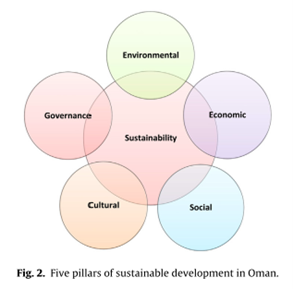
Al-Jebouri, M. F., Saleh, M. S., Raman, S. N., Rahmat, R. A. A. B. O., & Shaaban, A. K. (2017). Toward a national sustainable building assessment system in Oman: Assessment categories and their performance indicators. Sustainable Cities and Society, 31, 122-135.
The new generation of sustainable building-rating systems especially in developing countries is geared toward incorporating the variations in regional social, cultural, governmental and economic aspects. Likewise, the Sultanate of Oman possess its unique local context, geographical conditions, traditions and culture. The governmental and political requirements including the Omanization program, have also been highly considered in the Oman National Comprehensive Human Development 2040. The National Development Plan 2040 of Oman aims to bring the country into a more a sustainable life style. The aim of this study is to develop a framework for sustainable building construction in Oman by proposing an assessment system for the construction industry. While addressing sustainability, the system should respect the unique context of Oman in terms of its unique geographical, political, cultural, and societal features. No dedicated sustainability-rating system currently exists for Oman. Hence, this study involves two main stages to establish the sustainability assessment system for Oman. The first stage concentrates on further developing the formulation of the proposed system structure in relation to Oman by reviewing the literature on sustainable development and buildings, as well as analyzing international and regional sustainability-rating systems. The structure of the proposed system development is composed of 5 themes (environmental, economic, social, cultural and governance requirements), 11 categories, and 86 indicators. The second stage focuses on formulating assessment categories and their relevant performance indicators, which are validated through conducting a survey including different stakeholders of the industry from building engineers, building regulators, and sustainability experts. Pairwise and direct ranking method comparisons are used as data collection methods to examine the relative importance and weights of each category and each indicator respectively. The analysis of survey data shows that a prominent relative importance and balanced weights are given to indoor environment quality, natural and human resources, social, and governance requirements. The research output shall help and promote future studies to develop a detailed assessment system for sustainable construction in Oman.
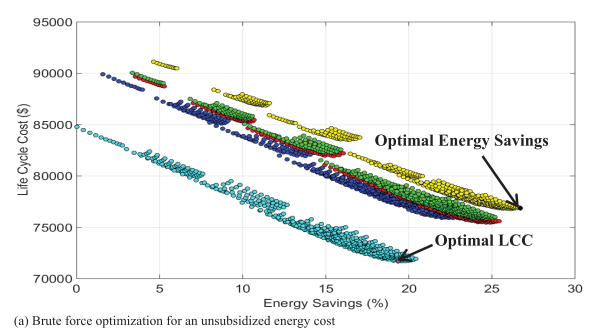
Al-Saadi, S. N., & Al-Jabri, K. S. (2017). Energy-efficient envelope design for residential buildings: A case study in Oman. In 2017 Smart City Symposium Prague (SCSP) (pp. 1-8). IEEE
This study summarizes the results from a simulation study for a typical villa in Muscat, a hot humid city in Oman. A housing model was generated in the DesignBuilder software. The model was compared against real utility readings before it was further taken for the energy calculations. Different thermal characteristics of building envelope including the heat transmission, thermal mass, solar heat gain through windows and air infiltration were evaluated. Many energy-efficient envelope design options were generated. Sensitivity analysis was then performed to narrow down the design parameters to the most significant parameters. From the sensitivity analysis, it was found that no significant energy savings are achieved beyond 15 cm of thermal insulation for both walls and roof. The solar heat gain coefficient (SHGC) was found more significant than the U-values of the glazing. It was also found that the house should be air tight as the air infiltration was significant. External shading was advantageous too in hot climates. A brute force optimization approach was then carried out using unsubsidized and subsidized energy cost scenarios. A maximum energy savings of 26.7% and a minimum energy savings of 18.4% were achieved for both energy cost scenarios. For maximum energy savings, 15 cm insulation for walls and roof, a double low-e selective tinted glazing, 100 cm of overhang shading were found to be the optimal design. The optimal designs for minimum life cycle cost were, however, different for the two energy cost scenarios. For unsubsidized energy cost, 10 cm insulation for walls and roof, a single green tinted glazing, and 100 cm of overhang shading were found to be the optimal design. For subsidized energy cost, a 7.5 cm for wall and roof are the optimal while other parameters are similar to the unsubsidized case. The results from the study will help both the policy makers, designers, and owners to select their optimal designs based on different cost functions.
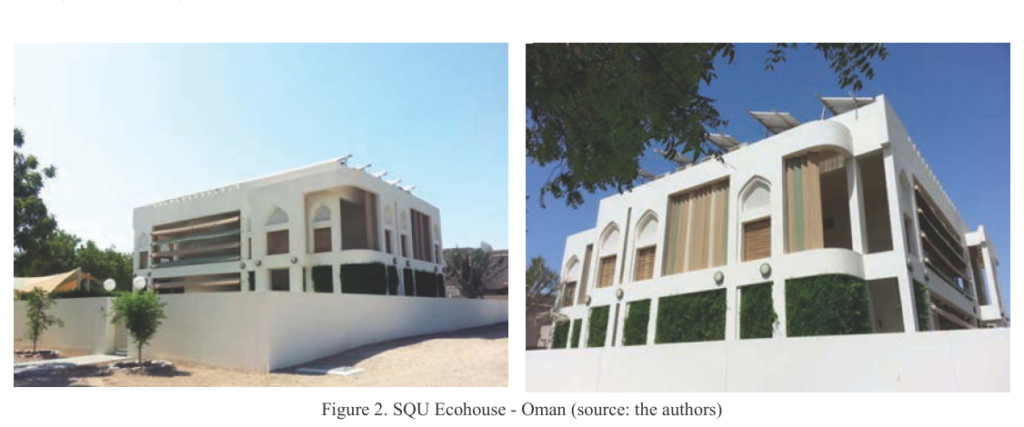
Alalouch, C., Saleh, M. S., Al-Saadi, S. (2016). Energy-efficient house in the GCC region. Procedia – Social and Behavioral Sciences, 216, 736-743
The residential sector is a major contributor to energy consumption and carbon emissions. The concept of energy-efficient house appeared as a response to the need to reduce energy demand in this sector. Energy-efficient houses have been designed and constructed widely in cold regions, the concept is however still under experimentation in extreme hot and arid climates such as in the Gulf Cooperation Council (GCC) region where the priority is to reduce space cooling load. This paper examines the concept of energy-efficient house and its applicability to the GCC region by reviewing two case studies where energy-efficient houses were designed and constructed. The paper concludes with GCC-specific considerations regarding the design and construction of energy-efficient houses and recommendations for future research.
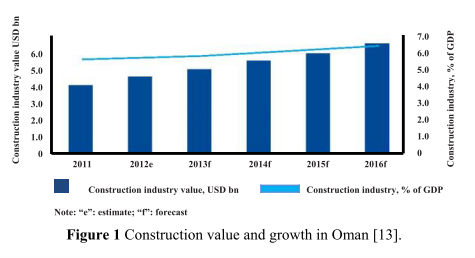
Saleh, M., S. and Alalouch, C. (2015). “Towards Sustainable Construction in Oman: Challenges & Opportunities”. Procedia Engineering, 118(C), p.178-185
Over the past few decades, Oman is experiencing a rapid economic growth associated with the flourishing and maturity of the oil production. The construction sector has seen to be the primary beneficiary with the blooming of many new infrastructure projects that serves the rapid urban development. In line with the booming awareness of the sustainable development of its neighboring countries, many proactive actions from the government and professional bodies attempts to introduce the sustainability concept to the industry. However, the lack of evidence on sustainability progress suggests that these values are not yet at the top of the construction industry agenda.This paper reviews the current application of sustainability in the construction industry in Oman. Informative challenges and opportunities have been identified through market surveys and a qualitative observational research method of current eco-house construction project conducted by Sultan Qaboos University within a competition initiated by the research council in Oman. The proposed recommendations of this study shall help promoting and improving the sustainability application in the Omani construction practices in the future.